
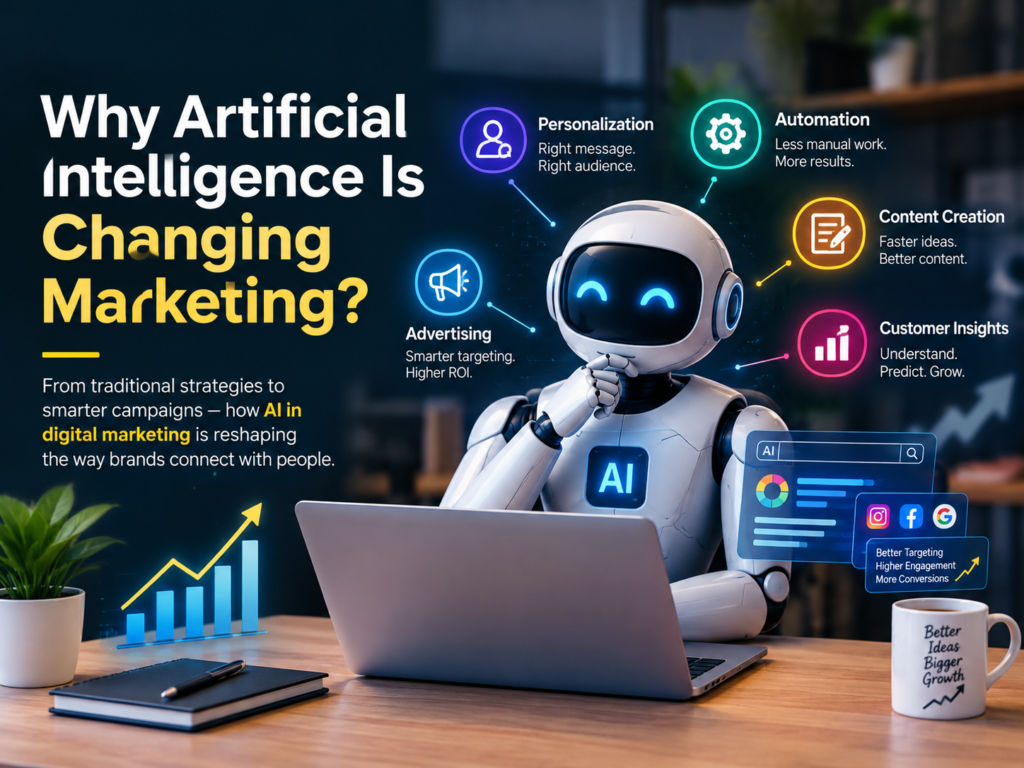
Marketing has always changed with technology—from newspapers and television to websites, social media, and mobile advertising. Today, another major shift is taking place: Artificial Intelligence (AI) is becoming an important part of how businesses understand customers, create content, run campaigns, and make marketing decisions.
This shift is making AI in digital marketing more than just a technology trend; it is becoming part of everyday marketing workflows.
The scale of adoption shows why businesses are paying attention. McKinsey’s 2025 global AI survey found that 71% of organizations regularly use generative AI in at least one business function, with marketing and sales among the functions where it is most commonly used. (McKinsey & Company)
This does not mean every company has completely transformed its marketing, but it shows how quickly AI is moving from experimentation toward practical business use.
One of the biggest changes is the move from traditional, one-size-fits-all marketing to data-driven and personalized marketing. Instead of creating one message and showing it to everyone, businesses can use AI to analyze customer behavior, interests, previous interactions, and purchase patterns. This allows marketers to create more relevant campaigns and deliver the right message to different audiences.
Content creation is another area where AI in digital marketing is making a noticeable difference. AI tools can help marketers brainstorm blog topics, create initial drafts, generate social media ideas, analyze keywords, develop ad variations, and personalize communication.
This can reduce repetitive work and give marketers more time to focus on strategy and creativity.
Advertising is changing as well. AI can analyze campaign performance, identify patterns in customer behavior, help segment audiences, and support real-time optimization.
McKinsey reports that marketers are increasingly using AI to understand consumers, communicate with them, and redesign workflows around AI capabilities.Personalization is becoming particularly important.
A 2026 McKinsey analysis notes that nearly half of consumers already use AI-based search to help with purchase decisions, indicating that the customer journey itself is changing.
Ultimately, AI in digital marketing is not simply about replacing human marketers. It is about combining machine intelligence with human creativity, judgment, and brand understanding.
As businesses adopt AI in digital marketing, the marketers who learn how to use these technologies strategically will be better positioned to adapt to a faster, more personalized digital environment.